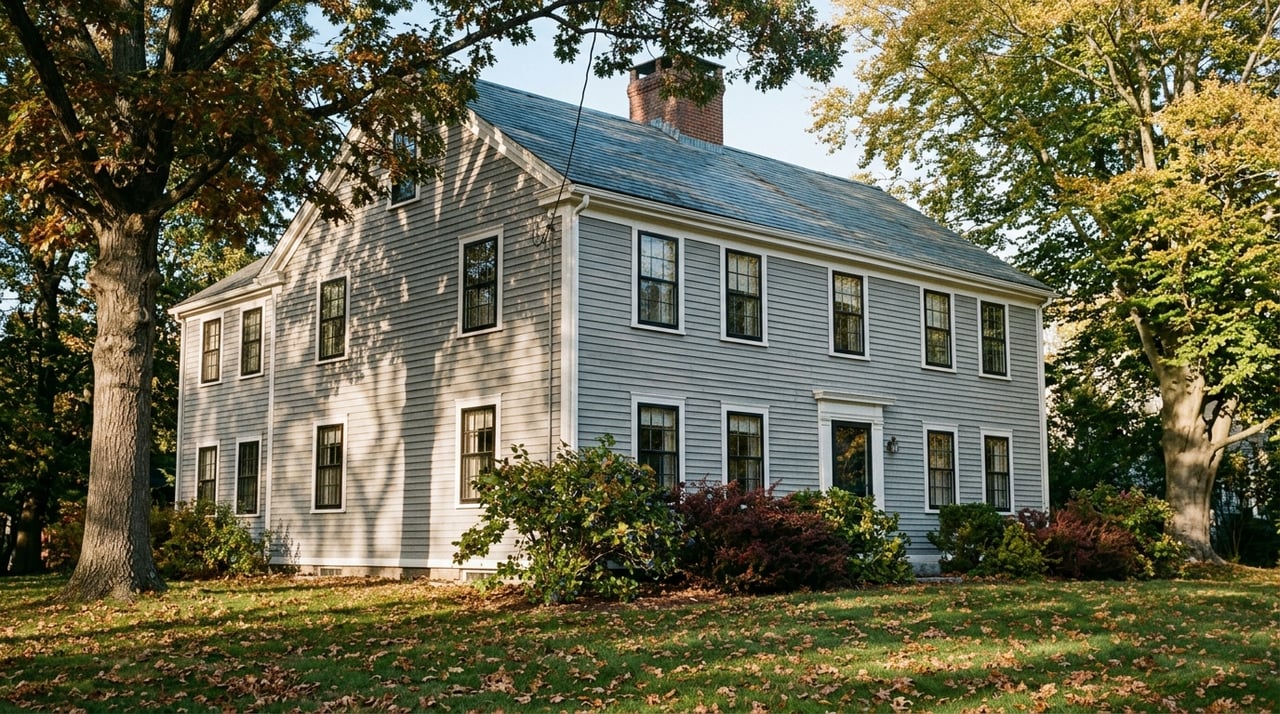
In April 2025, a Litchfield homeowner named Kathleen Donohue asked the Borough of Litchfield Historic District Commission for permission to put up an 8-by-10 shed. That same month, Adam Sherwin and Amey Win asked the Commission to approve two propane tanks at their home on Old South Road. Neither request was unusual. Both went through the same public hearing process the Commission uses to review additions, driveways, and second-floor windows.
That's the part most buyers don't expect. If you're picturing historic district review as something that only kicks in for major additions or a full restoration, the actual record says otherwise. In the Borough of Litchfield, a shed and a mansion-scale renovation start in the same place: an application for a Certificate of Appropriateness, reviewed by the same eight volunteer commissioners, on the same twice-a-month schedule.
The Line Between Your Yard and a Public Hearing
The Borough of Litchfield's historic district was the first one Connecticut ever created, established by a special act of the General Assembly in 1959. A portion of it earned National Historic Landmark status in 1968, and by 1978 the entire borough, more than 475 structures, was listed on the National Register of Historic Places. That history is why the review process exists, but it's the mechanics that catch buyers off guard.
Connecticut General Statutes Section 7-147a and the Borough's own Chapter 12 code give the Historic District Commission authority over any exterior feature visible from a public way, even if it's currently screened by trees or shrubs. That authority isn't limited to walls and rooflines. Recent Commission agendas show applications for a circular driveway on East Street, a pool-side pavilion on North Street, solar panels on West Street and Spencer Street, a rebuilt chimney with new bluestone caps on Prospect Street, and a request to simply remove old storm doors on Torrington Road. Even the Litchfield Housing Authority needed a Certificate of Appropriateness before building new multi-unit housing on East Street.
The Commission meets the first and third Thursday of each month at the Pilgrim House, 21 Torrington Road. If your project isn't on that month's agenda, you wait for the next one. That calendar, not your contractor's schedule, sets the pace for anything visible from the street.
What Actually Needs a Hearing, and What Doesn't
There's one narrow exception. The Litchfield Historic District Commission allows the property owner to request a Waiver Certificate at any Commission meeting if a repair exactly duplicates what's already there, in both design and material, instead of going through a full public hearing. Replace a broken clapboard with matching clapboard, and that's usually a quick sign-off.
Almost everything else requires the full process:
| Situation | What the Borough of Litchfield requires |
|---|---|
| Repair that exactly matches existing material and design | Waiver Certificate, handled at any regular meeting |
| Any visible change: new driveway material, fences, sheds, propane tanks, solar arrays, signage | Certificate of Appropriateness, full application and public hearing |
| New construction or additions | Certificate of Appropriateness |
| Approved work not completed within a year | The Commission's May 1, 2025 minutes state that a Certificate of Appropriateness is valid for one year; its May 1, 2025 agenda records extension applications for expired approvals, back before the Commission |
That last row matters more than it sounds. In 2025, a homeowner on North Street had to request extensions on three separate previously-approved applications, covering a cedar fence around HVAC and propane equipment, a gravel loop driveway, and a dormer on a carriage house, because the original one-year approval windows had lapsed before the work was finished. A Certificate of Appropriateness isn't a permanent green light. It expires.
Why This Belongs in Your Renovation Budget, Not Just Your Timeline
Solar is a useful example of how the district shapes a project before it even starts. Panels on a roof plane that isn't visible from the street tend to move through review without much friction. Panels facing North Street or South Street draw closer scrutiny, and installers who work in the district routinely build in several extra weeks for that additional review. If you're budgeting a solar install the way you would in a neighborhood without design review, you're planning around a timeline that doesn't apply here.
The same logic extends to almost any exterior upgrade. A driveway resurfacing, a new fence line, an outbuilding, a rooftop HVAC condenser, all of these carry a review step that a comparable home two miles outside the Borough line wouldn't need. None of it is unreasonable given what the district protects, but it's a real cost in time that belongs in the same conversation as the inspection contingency and the mortgage rate lock.
Not Every Litchfield Address Is in the District
One more distinction worth making before you fall in love with a listing: "Litchfield" the town and "the Borough of Litchfield" are not the same footprint. The historic district's boundaries are coterminous with the roughly one-square-mile Borough, centered on the Green and radiating out along North, South, East, and West Streets, with Prospect Street and Sheldon Lane included as well. Homes outside that boundary, elsewhere in the wider Town of Litchfield, answer to the town's regular Building Department and Planning & Zoning process without the added layer of Historic District Commission review.
For a buyer, that means the address on the listing sheet doesn't tell you which set of rules applies. A property on North Street is almost certainly inside the district. A property a few miles out toward Bantam or Northfield likely isn't. Knowing which one you're looking at changes what you should ask before you write an offer.
Why Buyers Still Pay a Premium for the Paperwork
None of this seems to be scaring anyone off. In June 2026, the 1775 Benjamin Tallmadge House at 47 North Street sold for $2,600,000 after a decade of what the listing described as museum-quality restoration, with grounds designed by landscape architect Michael Trapp. That kind of sale doesn't happen by working around the Historic District Commission. It happens by working with it, documenting original details, sourcing period-appropriate materials, and treating the review process as part of the project plan rather than an obstacle to it.
That's the piece the friction narrative misses. The same commission that requires a hearing for a shed is the reason North Street still looks like North Street, which is precisely what a buyer is paying for when they choose a house here over a comparable antique colonial in a town without design review.
If You're Selling: What to Resolve Before You List
Sellers in the Borough carry their own version of this. If there's exterior work on the property, an addition, a fence, a driveway change, that was never brought before the Commission, or a Certificate of Appropriateness that expired before the work was finished, that's a conversation to have with your attorney before the house goes under contract, not during a buyer's final walkthrough. A gap in that paper trail can slow a closing or become a negotiating point once a buyer's attorney starts reviewing title and permit history.
A Few Questions Worth Asking Before You Commit
Does this apply to anything inside the house? No. The Commission's jurisdiction is limited to exterior features that are visible from a public way. Interior renovations go through the standard Building Department process only.
What if I buy a house where past work was never approved? That's a title and disclosure issue best raised with your attorney during due diligence, since unresolved exterior work can surface later when you try to get your own Certificate of Appropriateness for something new.
How long does a Certificate of Appropriateness actually take? It depends on the meeting calendar and the complexity of the request. Straightforward items are often decided at the first hearing. Anything involving new construction, sightline questions, or additional documentation can take longer, especially if it lands on an agenda that's already full.
Where Local Guidance Actually Pays Off
The Historic District Commission's rules are public record, but knowing how they play out in practice, which projects sail through and which ones need extra documentation before the hearing, is the kind of knowledge that only comes from watching this market closely and for a long time. That's the work E.J. Murphy Realty does for buyers and sellers across Litchfield, whether the property in question is a North Street antique or a house well outside the Borough line where none of this applies.
If you're weighing a purchase inside the historic district, or trying to price a sale that involves it, get your free home valuation with our Litchfield experts before you make your next move.
This article is general information, not legal, tax or financial advice. Consult a qualified professional about your situation.